People ask us this at the front desk more than just about anything else. Horses aren't native to North America, so whatever's out on that marsh today arrived somehow in the last four hundred years and then got loose. How they managed it is the part nobody can agree on.
If you grew up on Misty of Chincoteague, you already have an answer. Mrs. Marguerite Henry put the Spanish galleon version into print in 1947, and that book has been selling steadily ever since, so the shipwreck is what most pony people were raised on. It's a wonderful story. It's also only one of three.
Nobody has ever proved any of them outright, though the galleon has picked up some real support lately from a horse tooth dug up in Haiti.
The short version: the National Park Service says colonists turned their livestock loose on Assateague in the late 1600s to get out of fencing laws and livestock taxes. The Chincoteague Volunteer Fire Company, which owns the herd that swims every July, says they came off a wrecked Spanish ship. Both have been working with these animals for generations, and neither one can prove it.
Did the Chincoteague ponies come from a shipwreck?
Maybe. Nobody's ever found the paperwork.
The picture Mrs. Henry painted is a Spanish ship carrying ponies hitting a shoal offshore, breaking apart, and the horses swimming free and dragging themselves up onto the beach.
It's not as far-fetched as it sounds. Two Spanish ships really did go down off this coast. The La Galga was a fifty-gun frigate of the Spanish Royal Navy that left Havana escorting a convoy in 1750, got driven off course by a hurricane, and ran aground on September 5 near what's now the Maryland and Virginia line. The Juno went down in 1802. Our coast is shoaly enough that they eventually built the Assateague Lighthouse over the problem.
Here's the part that keeps the story alive. Not long after the La Galga came ashore, the inlet where she wrecked closed up, and islanders started reporting small horses running on the beach. Spanish archives list about sixty soldiers aboard. Most of the crew made it. No horses were ever found or accounted for.
An author named John Amrhein Jr. spent years in the Spanish archives building the case and published it as The Hidden Galleon. In 1999, Virginia and Spain went so far as to agree on how they'd divide the rights to the wrecks. What nobody's turned up is a manifest listing horses, and folks have been going back and forth about it for the better part of three centuries.
Then in 2022 the argument got a good deal more interesting, and it happened because of a tooth. Archaeologists working at Puerto Real, a sixteenth-century Spanish colonial town in northern Haiti, had pulled a molar out of the ground back in 1980 and filed it away as a cow. When researchers finally ran DNA on it, it turned out to be an adult horse, and the oldest complete mitochondrial genome of any post-Columbian domestic horse ever recovered in the Western Hemisphere.
Then they went looking for its closest living relative. Out of everything in the database, the nearest match was a Chincoteague pony. The two of them trace back to a lineage that started in Bronze Age Spain.
That's the strongest support the Spanish theory has ever had, and it made the national news when the paper came out in PLOS One. It's worth being careful about what it actually proves, though. It tells you our ponies carry Spanish colonial bloodlines. It doesn't tell you how those bloodlines got to Assateague, and a horse of Spanish descent could just as easily have been walked onto this island by a farmer as swum ashore off a wreck.
Did Blackbeard leave horses on Assateague?
There's no evidence for this one whatsoever, and we're still not going to be the ones who stop telling it.
The story goes that Blackbeard kept a wife on Assateague and left her horses he'd taken in raids down the Carolina coast, and that those horses got loose and stayed loose.
In its favor: he knew these waters about as well as anybody alive, and he did keep a remarkable number of wives up and down the Atlantic. It's the story you tell on a boat at dusk, and nobody has ever managed to rule it out.
Or did colonists hide them from the tax man?
This is the one most historians land on, and it's the least romantic by a mile.
Back in the 1600s, loose livestock was a genuine headache. Horses, cows, sheep and pigs got into the crops, so colonial law said you had to fence your animals in. It also said you had to pay tax on every head you owned.
Assateague took care of both problems at once. There was grass, there was shelter, and there was a natural corral made out of water. You could turn your animals loose across the channel, skip the fence, and be awfully hard to count when the tax man came around. Assateague in those days was brambles and dunes and marsh muck deep enough to lose a boot in, so nobody was wading out there on a hunch to take inventory.
Our founder, Don Leonard, told this version to reporters for decades.
So which one is right?
The two organizations closest to these ponies don't agree, which is worth knowing before somebody tells you it's settled.
The National Park Service, which manages the Maryland herd up on the north end of the island, is pretty direct about it:
The most plausible explanation is that they are the descendants of horses that were brought to barrier islands like Assateague in the late 17th century by mainland owners to avoid fencing laws and taxation of livestock.
The Chincoteague Volunteer Fire Company, which owns the Virginia herd and has managed it since 1925, holds with the shipwreck.
Both have been at this for generations. For whatever it's worth, Don told the tax story his whole life, and this family has never had much reason to doubt him. The Puerto Real tooth doesn't really change that. Spanish horses reached the mainland by plenty of routes that didn't involve sinking, and a farmer looking to dodge a tax bill would have turned out whatever stock he had on hand.
Whatever walked ashore first, the herd has taken in every horse anybody turned out on that island since, so there's a good deal else mixed in by now.
What the island did to them
However they got here, what happened next isn't up for debate, because you can walk out and look at it.
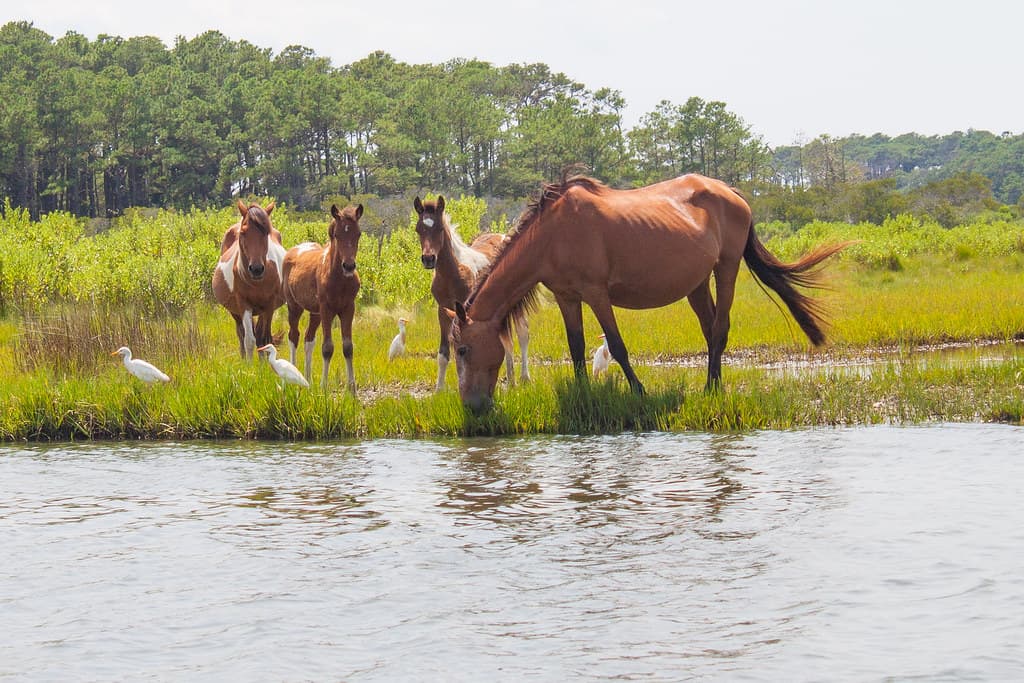
They grew thick, shaggy coats against the wind coming off the water. They learned to live on salt marsh cordgrass, which is poor feed, and that diet is why they're pony-sized instead of horse-sized. A grown Chincoteague pony stands twelve to thirteen hands, a little over four feet at the shoulder, stocky with a heavy mane. All that salt means they drink a lot of fresh water, which they somehow find on a barrier island, and it gives them the round-bellied look that surprises just about every visitor who asks us about it.
They didn't start out small. The island made them that way.
The bloodlines that came later
Don used to call the herd a Heinz 57 variety, and he meant it kindly. The Fire Company has brought in outside bloodlines over the years to keep the gene pool healthy, and it hasn't always gone the way anybody hoped.
Fifty western mustangs were turned out here and were gone inside a few years. They couldn't manage the salt marsh diet. Everything the island had spent centuries teaching our ponies, the mustangs never got the chance to learn.
A purebred Arabian stallion named Premier, brought in during 1995, did a great deal better. He was bred to sixteen Chincoteague mares and left ten foals behind, and you can still spot the Arabian in the wild herds today by the fine head and the thick arched neck. Premier spent some time on our family's farm before he was turned out on Assateague.
Two of his descendants, mares named Luna and Martha, are among the ponies who rotate through the pasture here at the Inn. They still run like Arabians, necks stretched out and tails up.
Ayden Leonard, who helps care for the herd year-round, tells the pasture side of Premier’s story in Pony Origins, from a Saltwater Cowboy.
Where to see the ponies today
The wild herds live on Assateague Island inside the Chincoteague National Wildlife Refuge, which starts a quarter mile from our front door. Your best odds are early morning or the hour before sunset, at Black Duck Marsh along Beach Road, at the Woodland Trail pony overlook, or from a boat. They're wild animals, so stay about forty feet back and please don't feed or touch them.
Our full guide to seeing them, including the Pony Swim, the spring and fall roundups, and how the buyback program works, is on our Wild Ponies page. If you'd like the family side of it, that's in Chincoteague Ponies and the Leonard Family Legacy.
Sources and further reading
National Park Service, Assateague Island. Virginia Places, Horses of Assateague Island. Delsol et al., "Analysis of the earliest complete mtDNA genome of a Caribbean colonial horse from 16th-century Haiti," PLOS One (2022). John Amrhein Jr., The Hidden Galleon. Marguerite Henry, Misty of Chincoteague (1947). Chincoteague Volunteer Fire Company. Details on Premier, the mustangs, and our own herd come from family records.
Featured photograph by Laura Davis of Tide & Thyme, used with permission.