
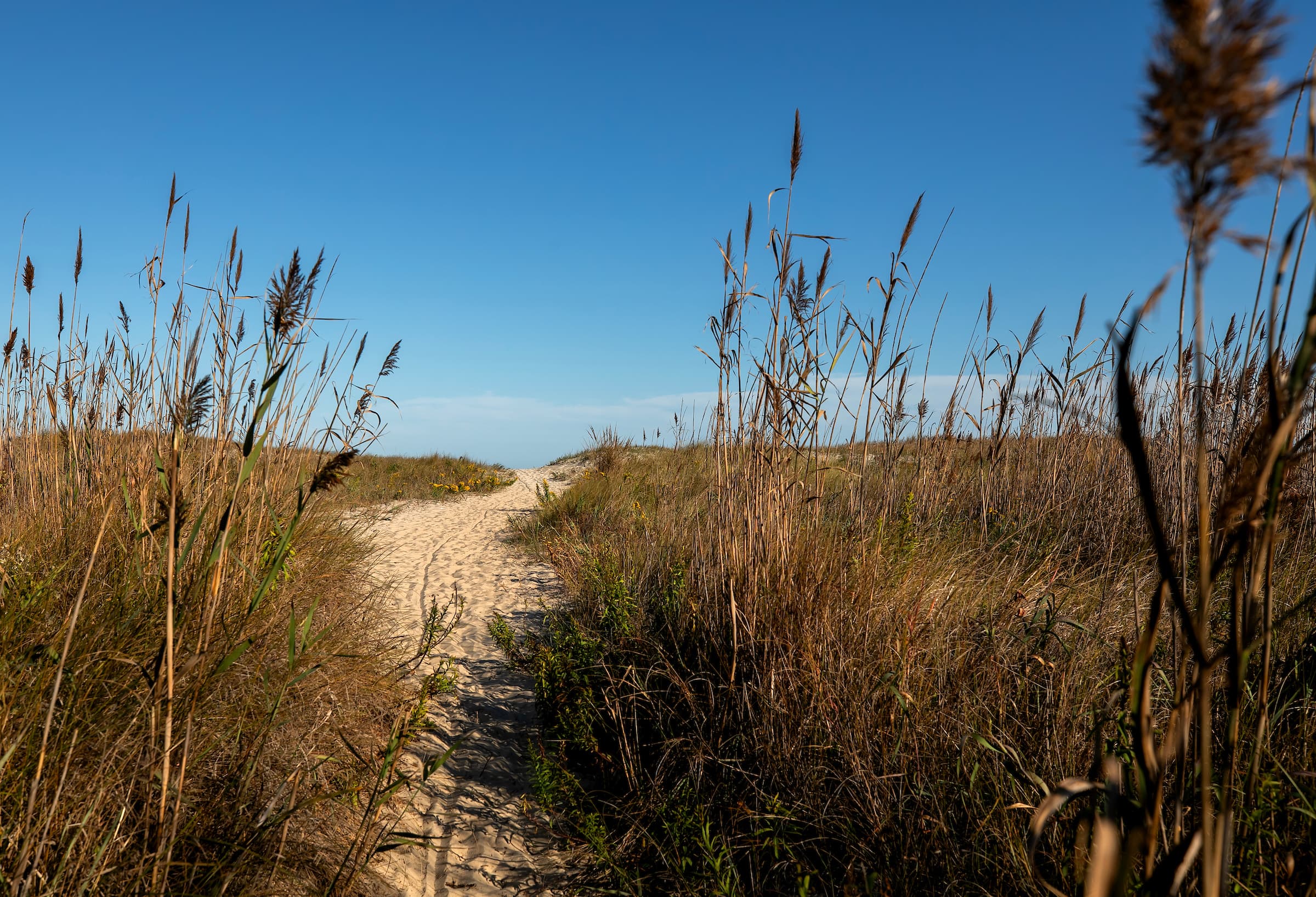
The entrance to Chincoteague National Wildlife Refuge is just a quarter of a mile from your room at the Refuge Inn — perfect for exploring the island on foot or by bicycle. Beyond the gate and bridge you’ll find fourteen thousand acres of beach, dune, salt marsh and maritime forest, along with fifteen miles of trail, nearly all of it flat and paved. The Fish and Wildlife Service calls this one of the most visited refuges in the country, but most of those visitors are bound for the beach on the National Seashore. The trails stay mostly quiet, other than the birds and the waves.
The refuge was established in 1943 as a haven for migratory birds, and it still serves that purpose today. The best way to see them is on foot or by bicycle. There’s another advantage to going that way: entrance via the Beach Road Trail is free. You’ll only pay if you’re in a vehicle without a National Parks Pass or Federal Duck Stamp.
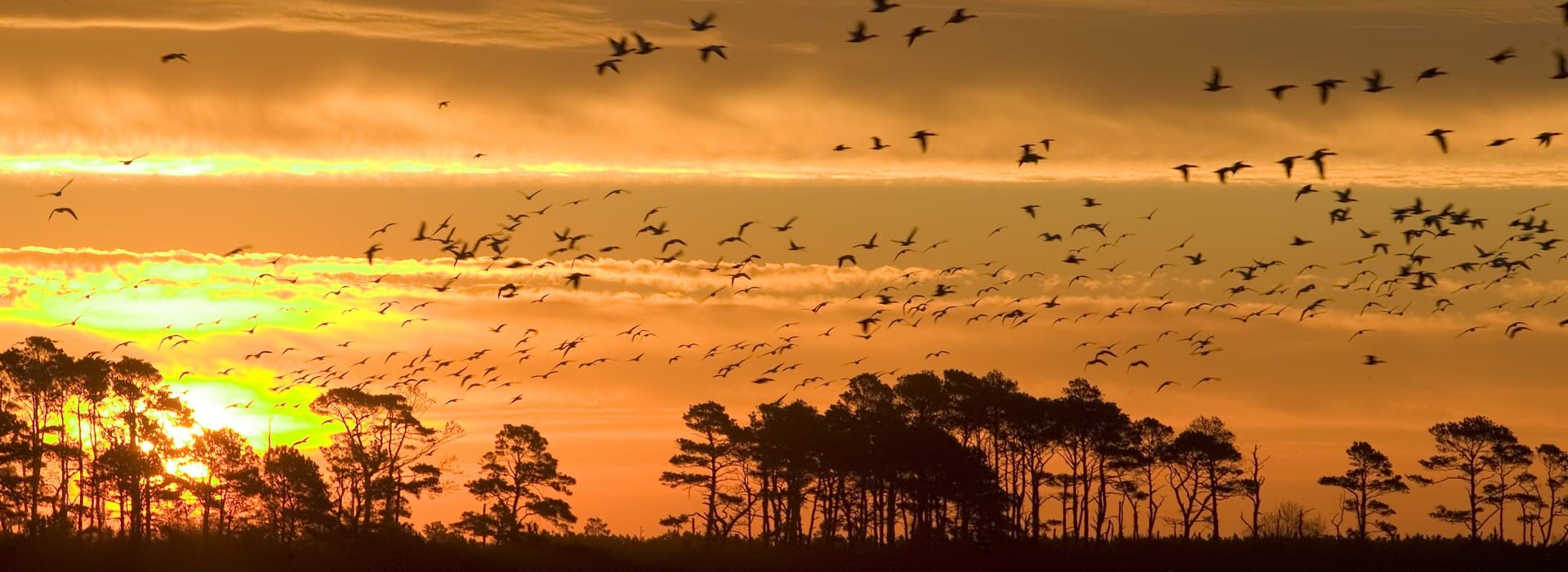
Sunrise over Chincoteague National Wildlife Refuge. Photograph by Steve Hillebrand, U.S. Fish and Wildlife Service.
The Wildlife Loop
The loop is the first walk most people take here, and the reason lies in the water it encircles rather than the pavement underfoot. The pool inside it is shallow fresh water held back from the salt marsh, and the refuge raises and lowers it through the year to suit whatever needs it most — deep in winter for the ducks and swans, drawn down in late summer until the mud comes up and the shorebirds can reach it. Birds that have crossed several hundred miles of open coast in the dark come down to it, and in the first hour of light the whole of that arrival is laid out within a few hundred feet of the road.
The loop is 3.2 miles of pavement around a shallow pool. It opens before dawn to walkers and cyclists, and to cars from 3pm until dusk.
In winter, the water along the Wildlife Loop is crowded and alive. Snow geese rise in sheets of several thousand, and the sound arrives a half-second behind the sight. Tundra swans show up in pairs or small flocks, and generally keep to the open water.
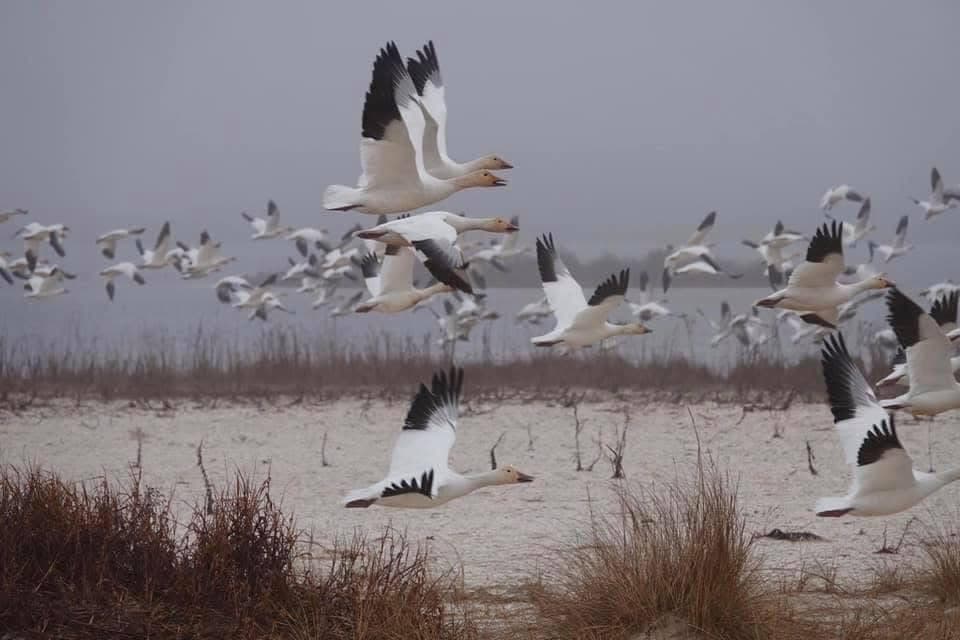
Snow geese over the refuge in winter, when the water on the Wildlife Loop is at its loudest.
Spring may be the loop’s best-kept secret. The trail passes through four kinds of country in a little over three miles — pine woods, freshwater pool, brackish edge and open salt marsh — and through April and May each of them is filling with different arrivals. Warblers and vireos work the pines along the first stretch, having come in overnight and needing to feed before they move on. The pool holds the last of the wintering ducks alongside the first returning terns. Out on the marsh the ospreys are back and rebuilding. Very little of it is the same from one week to the next, so it’s worth walking more than once in a visit.
By July the treetops are alive but the water has gone quiet: a snowy egret stands in its own reflection for long minutes together, a glossy ibis works the shallows with slow sweeps of its curved bill, and heat lifts off the asphalt in a shimmer through which the far bank wavers and reassembles.
Summer is not the quiet season it’s often taken for; it’s just a different cast. The wading birds are in breeding plumage and nesting out on the islands in the pool: great and snowy egrets, little blue and tricolored herons, glossy ibis. Diamondback terrapins and snapping turtles hide out among the banks. Fiddler crabs work the mud at the edges by the thousand, and the marsh is loud with clapper rails and red-winged blackbirds. Sika deer come out to the edges in the last hour of daylight. So do the mosquitoes, so start early.
By September the interest has moved to the last quarter of the loop, where falling water uncovers the mud and the shorebirds come to it — dowitchers and yellowlegs, dunlin, semipalmated and least sandpipers, and the plovers among them, all feeding on the same flat but at different depths, each according to the length of its bill. What looks at first like one flock is six or seven species keeping loose company, and the division of a single acre of mud among them is more orderly than almost anything else in the refuge.
The loop runs under open sky nearly the whole way round. That’s lovely in October and hard going in August — there’s very little shade or windbreak on the last half of the loop.
Swan Cove Trail
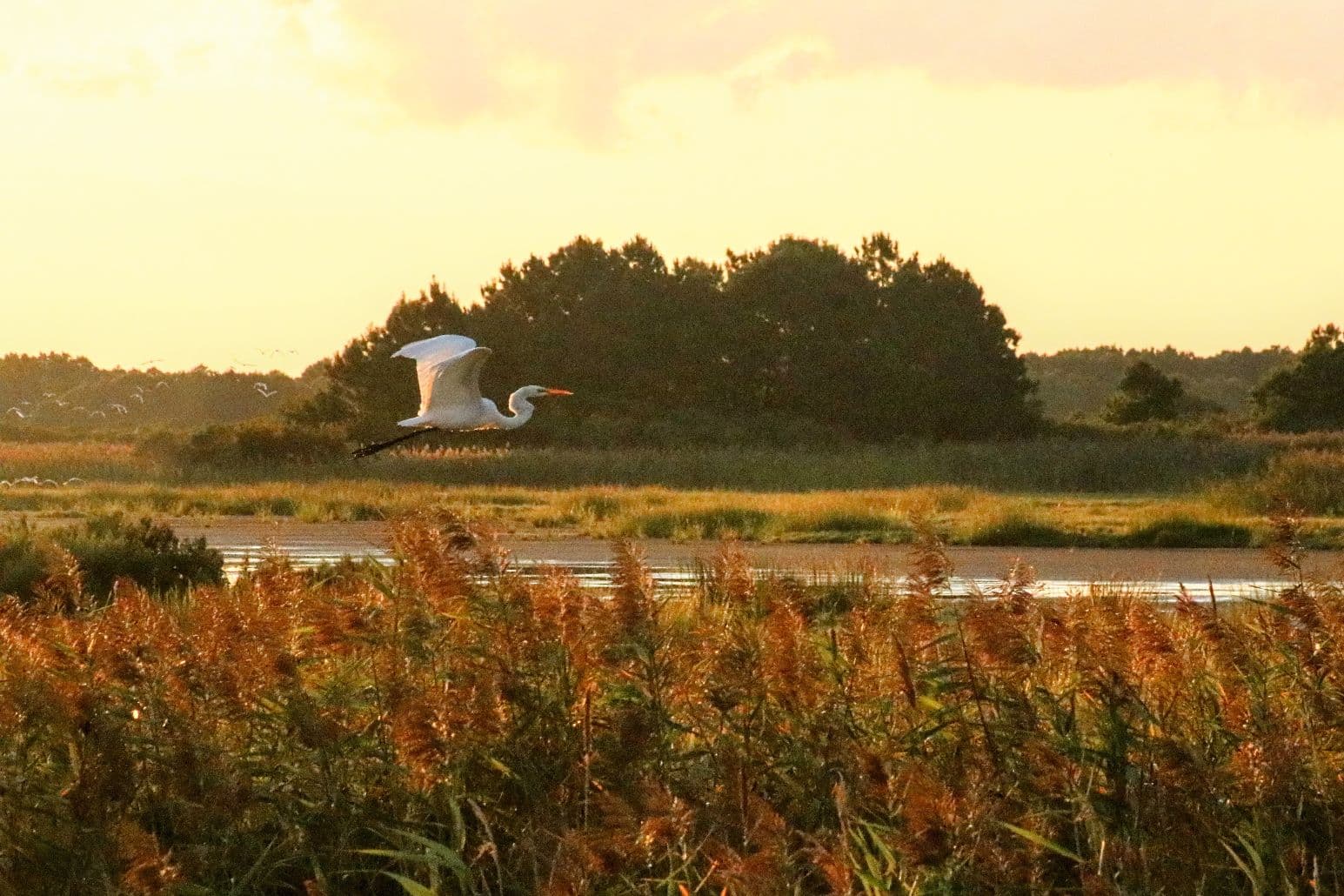
A great egret over the marsh in autumn. Swan Cove belongs to the wading birds through the warm months.
Swan Cove Trail is a spur of the Wildlife Loop which runs 0.36 miles from the loop to the Atlantic. This beach is quiet and secluded, as it’s only accessible to those on foot or bicycle. There is a bike rack at the end of the paved trail, since the sand is too soft to ride. This beach is just 3.5 miles from our door via the Wildlife Loop.
The walk also crosses three kinds of water in the space of an hour. Fresh water comes first, along the sides of the Wildlife Loop, then the brackish edge where muskrats cut their channels and an otter now and then surfaces to look you over before going under again, then dune and beach grass, and at last the sound of the waves of the Atlantic. Swan Cove itself fills in winter with swans, geese and all kinds of ducks. In summer it belongs to the waders, and the herons, egrets and ibis stalk the shallows in silence.
The Woodland Trail
A 1.75-mile paved loop through loblolly pine and maritime forest — about 1.9 miles if you visit the Pony Overlook.
The forest is not in perfect health, and that is a part of what makes it worth walking. Southern pine beetles have affected some of the trees — you’ll see them still standing despite being stripped of bark, with their trunks silvering. Woodpeckers have taken up residence there, and on a still morning you can hear several different species at once, all working at different pitches. Delmarva Peninsula fox squirrels cross the pavement, larger and grayer than the squirrels of the mainland. They are slower than most squirrels, and less easily alarmed. In May the canopy fills with colorful warblers, singing in the morning as they stop here on their migration route. They’ll be back in October, but are harder to find and identify since they sing less often and have far duller plumage. They will be traveling in loose company with chickadees and titmice; a flock will sometimes pass overhead in under two minutes and leave the wood silent behind it.
The Pony Overlook spur
This short boardwalk begins along the Woodland Trail and ends at a platform above one of the open fenced areas where the wild ponies live. Some mornings the herd grazes near enough that you can hear them tearing at the cordgrass. Other mornings there’s only marsh running green and gold to the horizon, and a single dark shape half a mile out that, to the naked eye, may or may not be a horse. Binoculars are your friend on this overlook!
The Bivalve Trail
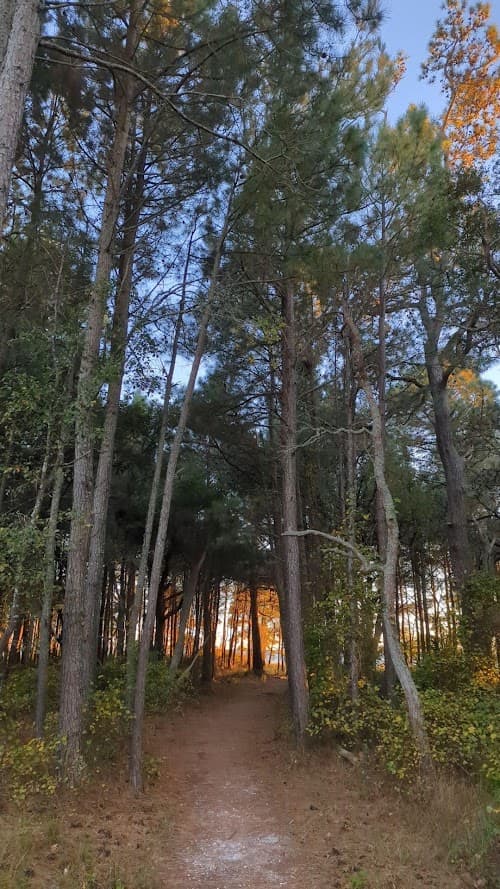
The Bivalve Trail, the one unpaved spur off the Woodland loop, running down through the pines toward Tom’s Cove.
This spur begins on the Woodland Trail and runs down through the pines to Tom’s Cove. It’s only 0.15 miles long, but it is a sand path so you’ll want to leave your bike and hoof it. It ends at a narrow strip of sand along the salt marsh. You can sometimes see watermen at work, and cormorants sunning themselves on a nearby duck blind. In the last hour of daylight, it’s the quietest place in the refuge, and it’s usually empty. The sunsets here are spectacular and as private as they come.
The Marsh Trail
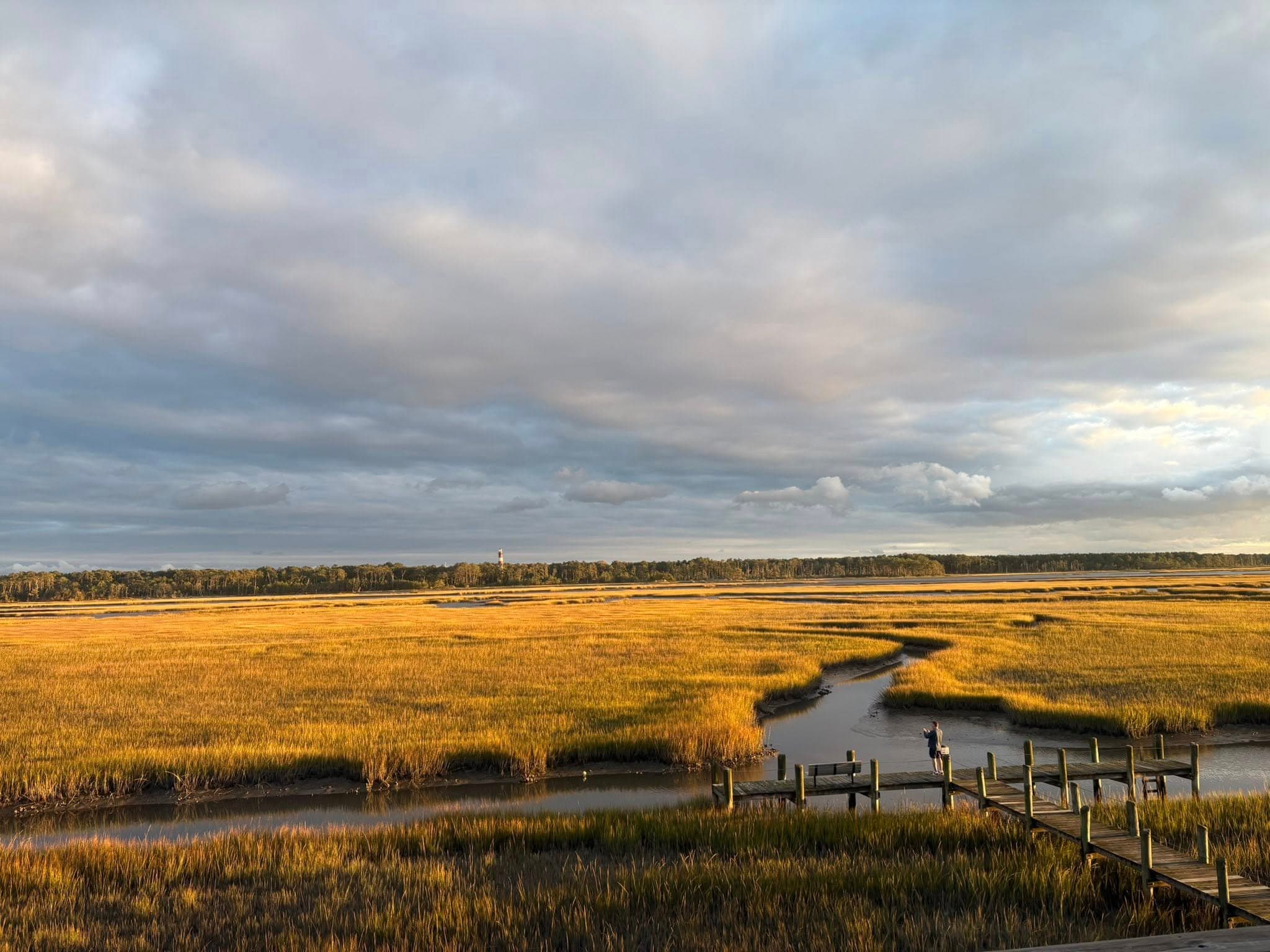
The marsh in autumn. The Marsh Trail ends at a raised platform above Snow Goose Pool.
The Marsh Trail lies inside the Wildlife Loop, near its exit, and you can reach it from the loop’s parking area. It consists of 0.63 miles of packed sand, stone and grass ending at a raised wooden platform above Snow Goose Pool. It’s the quietest of the short walks, and it offers a higher-up view that others can’t. From the platform, you’re looking down across the water, and that changes what you can pick out in the pool. Ducks that would be anonymous from the bank sort themselves into species, and a bittern you’d never spot against the mud stands out much more clearly.
Tree swallows hunt the air above the marsh grass here, and through the summer dragonflies lift from the path ahead of every footfall. Thirty minutes and a pair of binoculars are all you need to enjoy this path to the fullest.
Black Duck Trail
A little over half a mile of flat pavement linking the Wildlife Loop to the Woodland Trail — the connector that turns two separate walks into one continuous ride. The Fish and Wildlife Service lists it as a good place to look for turtles, songbirds and small mammals. Like the other paved trails, it has bumps where tree roots have lifted the asphalt.
The Lighthouse Trail
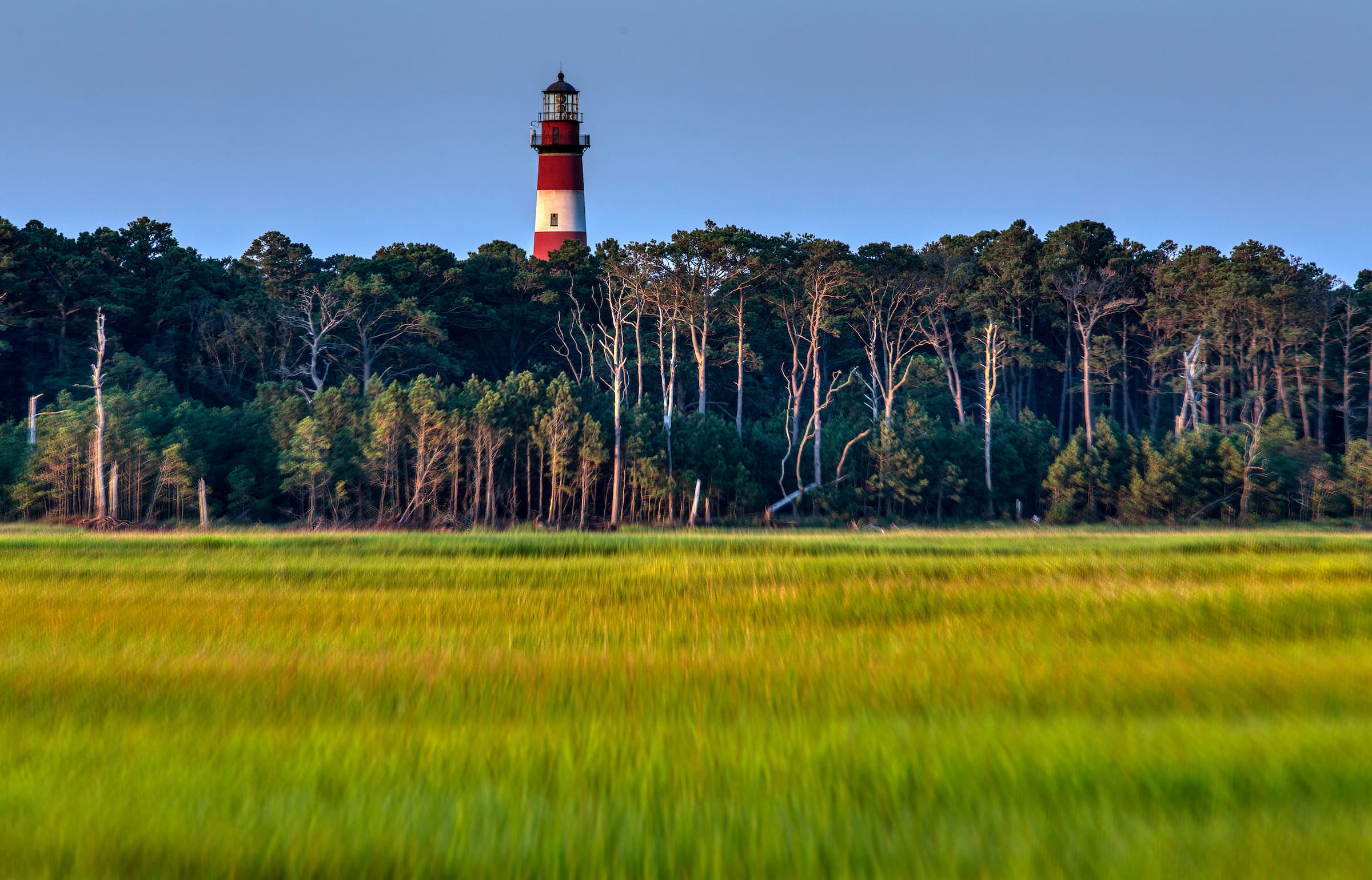
The Assateague Lighthouse at the top of the only climb on either island.
A short, steep, unpaved 0.3 mile trail leads you up through the woods to the foot of the Assateague Lighthouse, banded red and white and still warning ships offshore of the infamous shoals of Assateague.
It’s also the buggiest trail in the refuge, and the reason is simple: it is almost entirely shaded and sheltered from the wind. When you combine that with a wet forest, mosquitoes thrive. In high summer they’re serious. Cover your arms and legs, or come in April — October is a gamble, and August is reliably bad.
The trail itself isn’t wheelchair accessible — it’s unpaved and steep with many tree roots. For those unable to make the climb, the disabled access road opposite the visitor center runs all the way up to the lighthouse.
Beach Road Trail
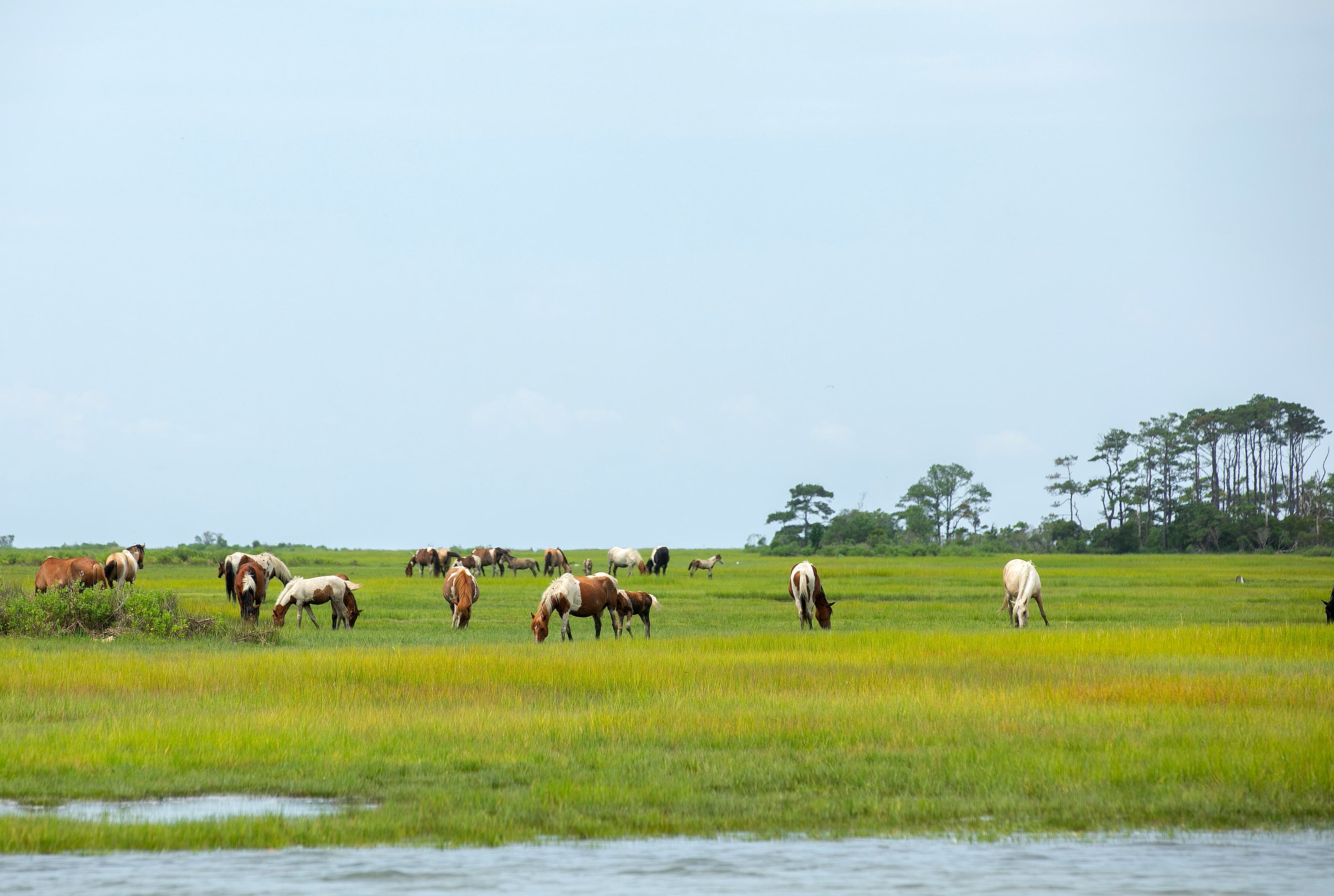
Wild ponies grazing at Black Duck Marsh, along Beach Road.
The paved Beach Road Trail runs just under two miles, from the Museum of Chincoteague out past the Wildlife Loop parking lot and on to the visitor center. It’s the piece of trail our guests use most, because it starts nearly at our doorstep.
The marsh alongside it is teeming with life. You’ll see great and snowy egrets, tricolored and little blue herons, and white and glossy ibis, all feeding within thirty feet of the path. Clapper rails call from the cordgrass, harsh and clattering — you’ll hear them far more often than you’ll see them. At low tide, mud flats and oyster rocks appear, drawing flocks of shorebirds.
Tom’s Cove Hook
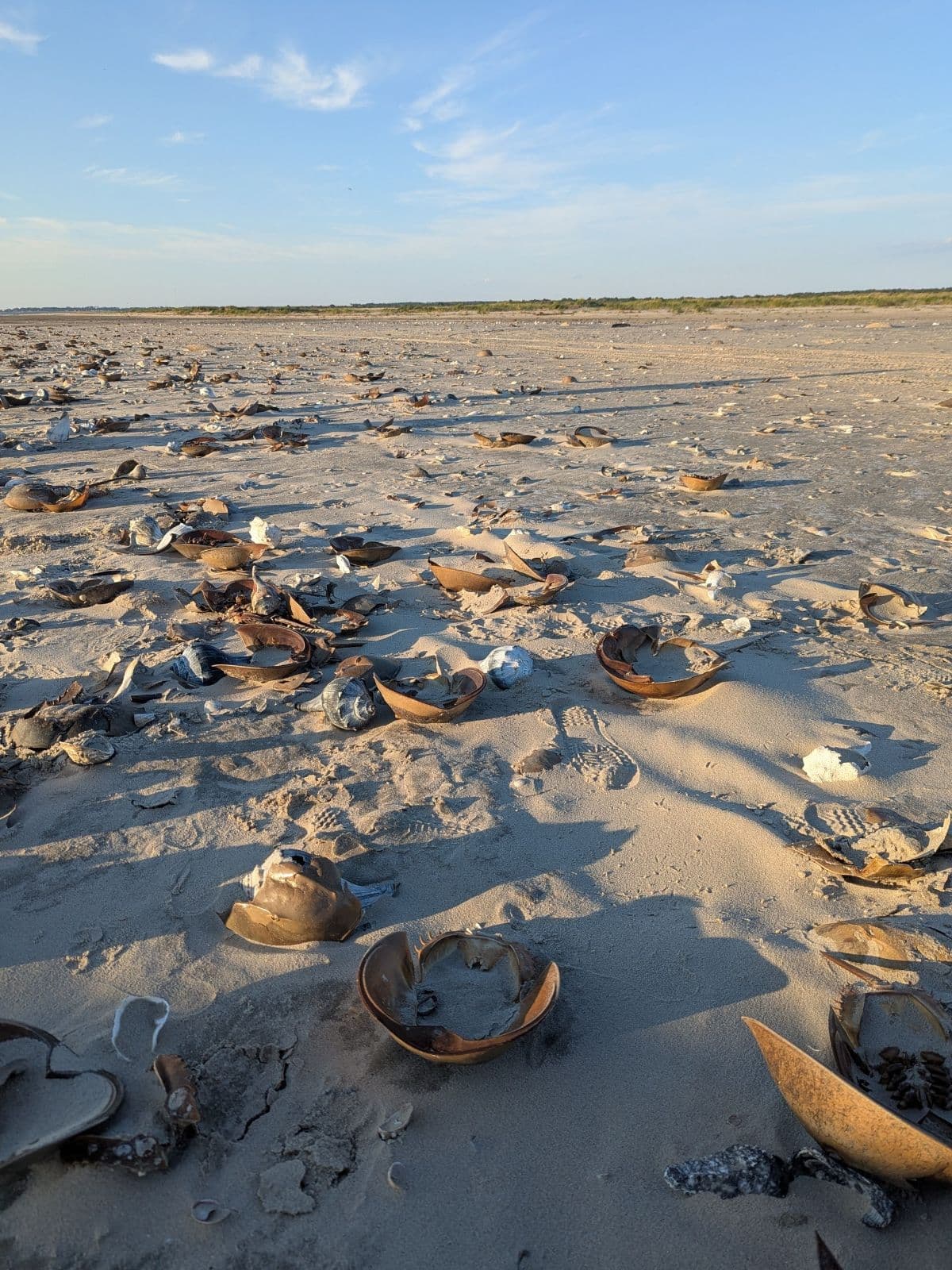
Horseshoe crab shells and whelks on the sand at the Hook, where the best shelling of the year is found.
The Hook is not actually a trail. It’s three miles of soft sand, crossing a sometimes narrow spit that the ocean rearranges each winter. Walking out to the end of the island, where it curves along the inlet, and back to the parking lot takes three to four hours at a decent clip. There is no shade, no water and no shelter anywhere along it. There’s also no shortcut back — however far out you walk, you walk it again.
It closes on the fifteenth of March each year so piping plovers can nest, and reopens when the chicks have fledged, usually near the first of September. The shorebirds are already there when it opens — oystercatchers, godwits, whimbrel, ruddy turnstones, dunlin, sanderlings and plovers of several kinds — and so is the best shelling of the year, whelks lying thick enough along the surf line that you pick your way between them. The walk back is best around low tide, when the water draws back, revealing a feast for shorebirds, a line of whelks, and firmer sand for tired hips and knees.
Carry more water than seems necessary, and wear old shoes. We have a full guide for the Hook here.
The Island Nature Trail
Not everything worth walking lies on refuge land. The Island Nature Trail, on Hallie Whealton Smith Drive here on Chincoteague, suits a quick morning or a lazy late afternoon: a 0.7-mile paved loop with benches along the south side of the road between our elementary and high schools, and a natural-surface loop of about 0.4 mile through pine and glade on the north side of the road. There is no entrance fee, no open or closing schedule, and leashed dogs are welcome on the paved side. Some native plants have also been marked by local naturalists. You’ll see many of the same birds here as you would on the Woodland Trail, since it’s a pine forest running near a brackish pond.
On a bicycle
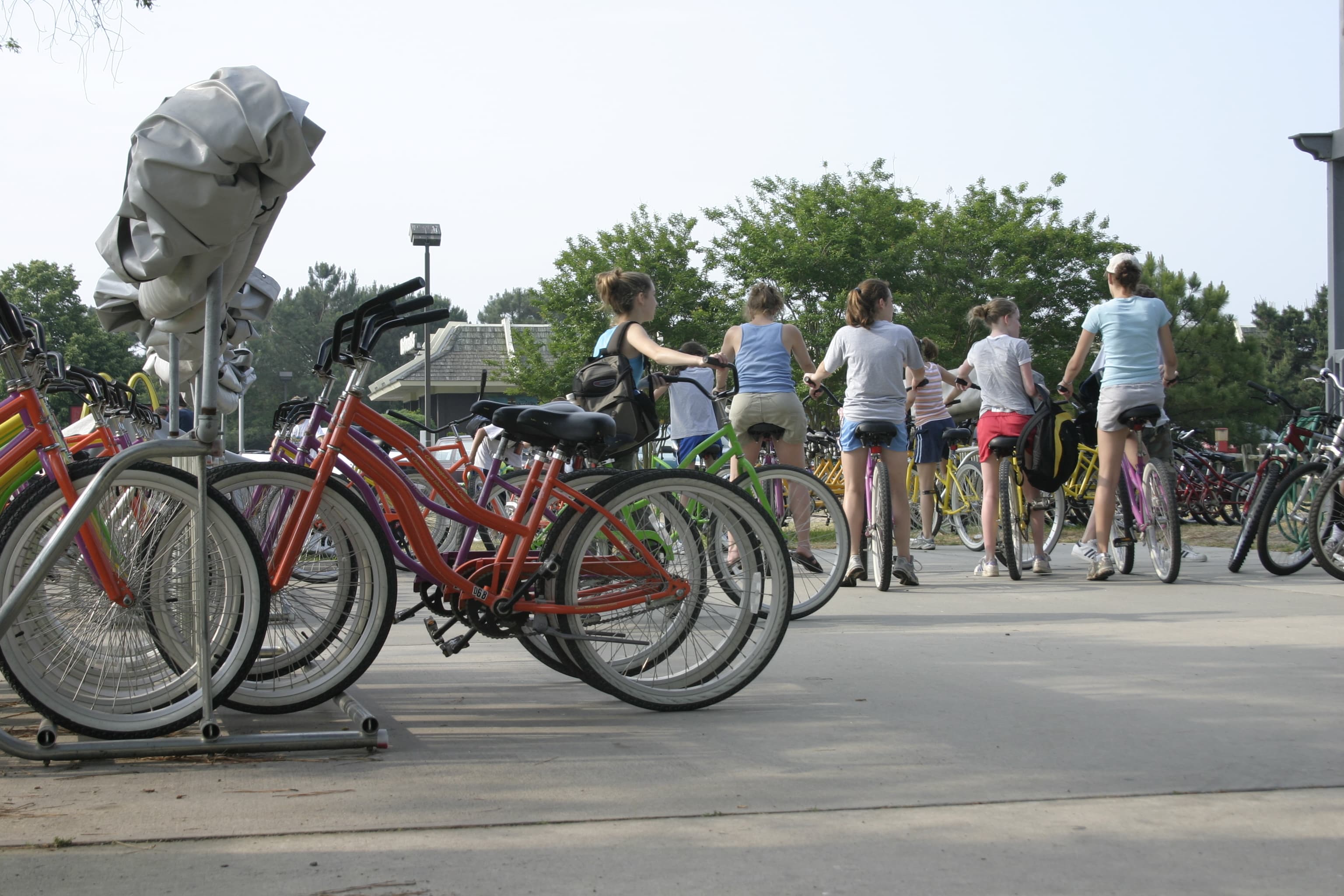
Rental bicycles outside the Refuge Inn. The Bike Depot is next door.
The refuge suits a bicycle as well as it suits a pair of boots: fifteen miles of flat paved trail, no hills to speak of, and a loop that is free of cars until three in the afternoon.
The Wildlife Loop is best ridden early, when it’s empty enough to stop in the middle of the road for whatever caught your eye in the trees or along the water’s edge. If you also take the Black Duck Trail to the Woodland Trail, you’ll cover most of the refuge before lunch.
If you only want to get to the beach, the Wildlife Loop to Swan Cove and down onto the sand is 3.5 miles from our door. Every foot of it is paved, and there is plenty to enjoy along the way. The loop opens to cars at three, and those cars are sometimes watching birds rather than cyclists. Tree roots have lifted the pavement in places, most of all along the Woodland Trail — paved here doesn’t necessarily mean smooth, so you may get a bounce if you hit them at speed. It’s worth noting that the Hook is not bike-friendly, because the sand is too soft.
Beach cruisers, tandems, children’s bicycles and bicycles with child seats or carts are all available to rent at the Bike Depot next door to the inn, which has been in the family since the 1980s.
Accessibility on the trails
Most of the refuge is spectacularly easy ground. The Wildlife Loop, the Woodland Trail, Black Duck Trail, Swan Cove and the Beach Road Trail are paved and flat, so a wheelchair, a walker or a stroller can reach the open water, the pine forest, the pony overlook and the edge of the Atlantic. Very few wildlife refuges anywhere can offer that.
The exceptions are worth knowing before you set out. The Lighthouse Trail is unpaved and steep. The Bivalve spur is narrow and sand. The Marsh Trail is packed sand, stone and grass — likely accessible, but it may be more difficult on wheels.
The caveat on paved trails is tree roots. They’ve lifted the asphalt into low ridges here and there, most noticeably along the Woodland Trail, and they can trip you up if you aren’t looking out.
The Wildlife Loop opens to cars at three in the afternoon, which puts the best waterfowl water on the island within reach of anyone who can’t walk it. The Beach Road overlooks allow for great birding right from the car. And the access road opposite the visitor center runs up to the lighthouse, which is an easy way to see it without the climb.
Down at the beach, the Park Service keeps beach wheelchairs at the parking lots in season and rolls mobility mats out over the sand. Availability thins in the off months, so it’s worth calling ahead to the visitor center rather than arriving to disappointment.
The Refuge Inn has two floors and no elevator, and rooms 135 and 136 are our accessible rooms. Our accessibility page has the rest of the detail, and we have written a longer guide to getting outdoors here with a disability.
Walking with children
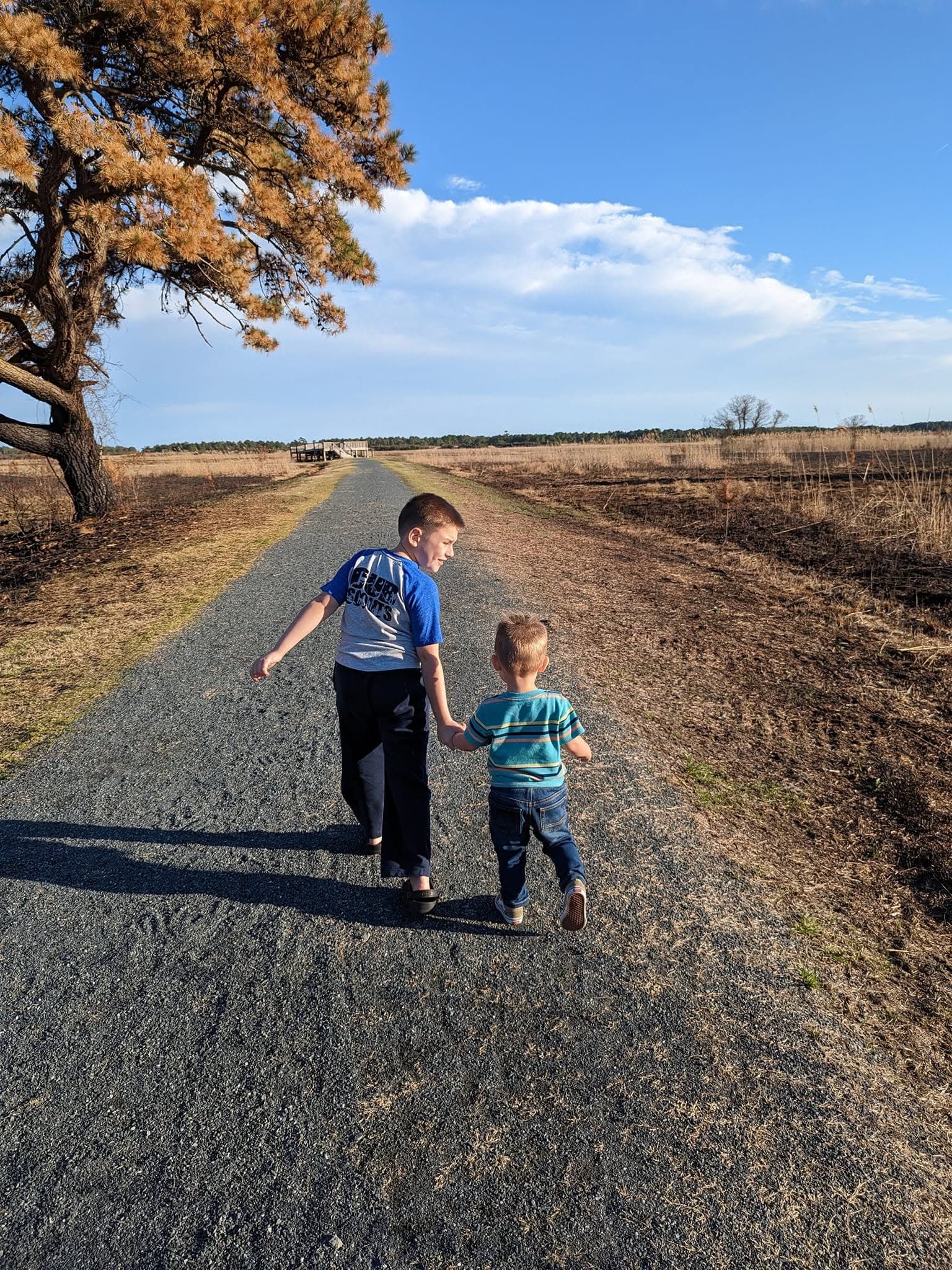
Two small walkers on the trail. The trick with children is not distance, it is stopping.
Flat pavement and no traffic before three is a rarer combination than it sounds. A five-year-old on their first two-wheeler can ride the Wildlife Loop in the morning with nothing to fear, and a stroller can go almost anywhere.
The difficulty with children is often not the distance itself, but how many times they’ll want to stop along the way. A walk that can be abandoned halfway through without anyone minding is the right sort of walk with little kids. A fiddler crab at the edge of the mud will hold a four-year-old’s attention longer than a mile of scenery, and the nuthatches working head-first down the trunks of our own pine trees beat any distant duck when you are six. The front desk keeps Birding Bingo cards: twelve easily identifiable birds a child will plausibly see, a gull and a cardinal among them, and a small prize for finding eight or more. We have more on birding with children here.
A few local warnings
The salt marsh that makes this place so good for birds also makes it good for insects, and from May into November they come with the territory. The good news is, bugs are predictable, and can usually be thwarted with a little planning.
Mosquitoes are at their worst at dusk, and worst of all about a week after rain — a good soaking followed by hot weather will hatch a hungry brood. In a dry or cool stretch they’re much less of a nuisance. The middle of the day is usually the quietest time for mosquitoes, but we recommend always carrying a bottle of repellent if you’re outdoors between the inn and the beach.
Greenhead and biting flies can be a problem in high summer, and they are seemingly immune to standard bug repellent. Long sleeves and long pants do more on a bad evening than any spray. The flies aren’t usually troublesome, but they can be bad on the beach when the air comes from the west, off their hatcheries in the marsh. An east wind off the ocean — which is typical here — keeps them back in the marsh where they belong. Most islanders check the wind before heading to the beach.
Ticks are around from spring through fall. Stick to the trail rather than cutting through the grass, and you should be fine. If you want to be super careful, tuck your pants into your socks on anything unpaved, and check your whole body when you get back to the room. Poison ivy also grows along the wooded edges, and turns a handsome red in October — but you’ll turn red as well if you come in contact with it. We have a first-aid kit at the front desk, should you need it.
The ponies are wild animals. The law requires you to stay forty feet back, about the length of a bus, and they have been known to bite and kick. They are usually fenced in, but ponies being ponies, they find their way out sometimes. Always give them a wide berth, especially around stallions and foals.
The sun can be brutal if you aren’t prepared for it. Beach Road, the Wildlife Loop and the Hook run open the whole way with very little tree cover, so in July an eight o’clock start is a wildly different experience from a ten o’clock start.
One more thing you may hear in the fall: a gunshot out over the marsh. Hunting is allowed around the refuge, in areas a safe distance from the trails, but the sound travels quite far on a quiet morning — don’t be alarmed.
And, something many people don’t realize: there’s nothing out there to buy once you’ve set off — no water, no shade, only a tiny souvenir shop at the visitor center. There are some nice port-a-potties at the beach and at some trail entrances, but you’ll absolutely want to pack in and pack out, giving special attention to water and food.
Questions walkers ask
Which refuge trails are wheelchair accessible?
The Wildlife Loop, the Woodland Trail with its Pony Overlook spur, Black Duck and Swan Cove are all paved, flat and listed as wheelchair friendly. Tree roots have lifted the pavement into small ridges in places, most noticeably on the Woodland Trail. The Marsh Trail is an unpaved footpath whose surface runs from packed sand to stone to grass; it’s flat, and Fish and Wildlife say it may work for some visitors using mobility devices. The Bivalve spur is sand. The Lighthouse Trail is not accessible — unpaved and steep — but the access road opposite the visitor center is open to visitors with mobility impairments. The Wildlife Loop opens to cars at three in the afternoon, and beach wheelchairs and mobility mats are available from the Park Service at the beach in season.
Do you need a pass to walk into the refuge?
No. The entrance pass is a vehicle pass. On foot or by bicycle there is no fee at all. From our door the gate is a quarter-mile walk. Current pass prices are on the U.S. Fish and Wildlife Service fees page.
Can you bike the trails at Chincoteague?
Yes, and it’s the best way to see the refuge in a morning. Fifteen miles of flat paved trail, no hills to speak of, and the Wildlife Loop stays closed to cars until three in the afternoon. Rentals are next door at the Bike Depot, which has children’s bikes, bikes with child seats and kiddie carts as well as adult cruisers and tandems. Soft sand, including the Hook, is for walking only.
Which trail is best for seeing the ponies?
The Pony Overlook spur off the Woodland Trail, which ends at a platform above one of the fenced areas. Sightings are never promised, and the herd may be far out in the marsh.
How bad are the mosquitoes?
It depends entirely on rainfall and temperature. A good rain followed by hot weather will hatch a brood about a week later, and those weeks are the ones to plan around. If it’s been dry or cool, they’re hardly a bother. The greenhead flies of high summer can also be a nuisance, especially when the wind is out of the west.
When is Tom’s Cove Hook open?
Roughly the first of September through the fourteenth of March. It closes on March 15 for the nesting piping plovers and reopens once the chicks have fledged.
Are dogs allowed?
No. The refuge allows no pets of any kind — not on the trails, not in the parking lots, not even left in your vehicle. Service animals only. The same goes for us at the inn: we can’t accommodate pets, though service animals are always welcome. The one place on the island that does welcome leashed dogs is the paved south loop of the Island Nature Trail.
Come and walk it
We are a quarter mile from the gate, which means the Woodland Trail and the Wildlife Loop are minutes from your room and free on foot. The pine-side balconies look into the loblollies where the warblers and the nuthatches feed, and the listening station on the grounds will tell you what has been calling here this month. Tell the desk the night before and your breakfast will be packed and waiting, so that you can be through the gate while the sky is still the color of a shell.
Check availability · (757) 336-5511 · More on birding here